Infrared transmitting pigment
High-Performance Optical Pigments for Infrared Transmission Applications
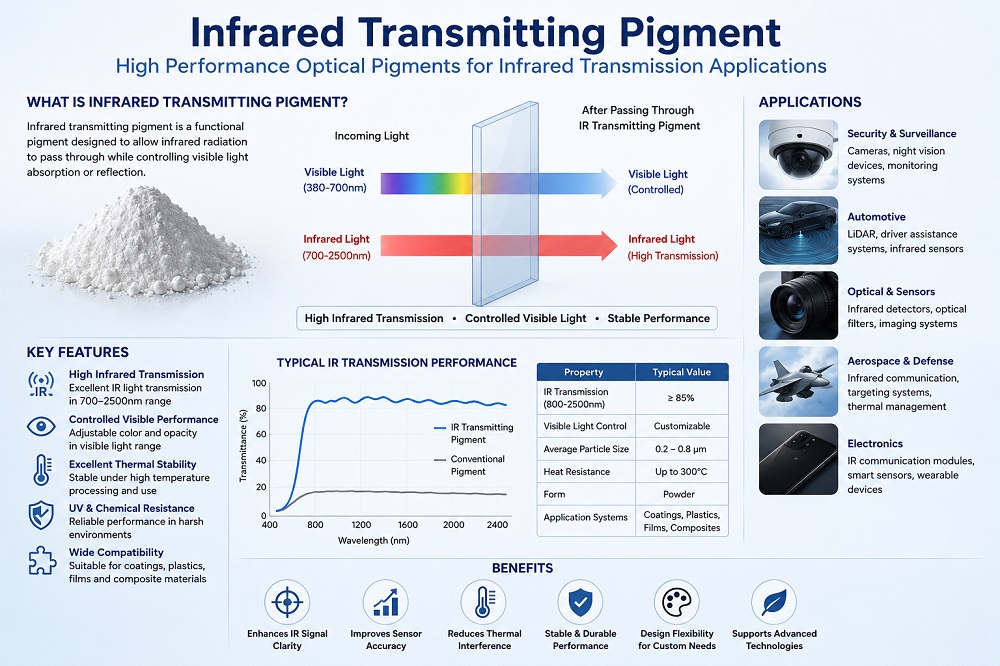
Infrared transmitting pigment is a type of advanced functional pigment designed to allow infrared radiation to pass through while selectively controlling visible light absorption or reflection. These pigments are widely used in optical systems, sensors, security devices, and advanced industrial applications where infrared transparency is required.
What Is Infrared Transmitting Pigment?
Infrared transmitting pigment refers to a class of functional materials engineered to transmit near-infrared (NIR) radiation while maintaining specific optical properties in the visible light range.
Unlike conventional pigments that block or scatter infrared light, IR transmitting pigments are optimized to:
- Allow infrared wavelengths (typically 700–2500 nm) to pass through
- Control visible light appearance (color, opacity, or absorption)
- Maintain stability under heat, UV exposure, and environmental conditions
These properties make them essential in modern optical and electronic applications.
Key Features of Infrared Transmitting Pigments
- 1. High Infrared Transmission Efficiency
Designed to maximize IR light passage while minimizing scattering or absorption losses.
- 2. Controlled Visible Light Performance
Allows engineers to adjust visible color appearance without affecting infrared functionality.
- 3. Excellent Thermal Stability
Stable under high-temperature processing conditions used in coatings, plastics, and optical films.
- 4. Chemical and UV Resistance
Suitable for long-term outdoor and industrial applications.
- 5. Compatibility with Multiple Systems
Can be used in coatings, plastics, films, and composite materials.
How Infrared Transmitting Pigments Work
Infrared transmitting pigments are engineered based on precise control of particle composition, refractive index, and absorption characteristics.
They function by:
- Minimizing absorption in the infrared spectrum
- Reducing scattering of IR wavelengths
- Optimizing particle size distribution for optical clarity
- Controlling electronic band structure to allow IR penetration
This enables efficient infrared transmission while still providing visible optical control.
Technical Advantages
Infrared transmitting pigments offer several key advantages over conventional pigments:
- Enhanced infrared signal clarity
- Improved sensor and detection accuracy
- Better performance in optical filtering systems
- Reduced thermal interference in infrared devices
- High design flexibility for optical engineering
Application Areas
Infrared transmitting pigments are widely used in advanced industries, including:
- 1. Optical and Sensor Systems
Used in infrared detectors, imaging systems, and optical filters where IR transparency is critical.
- 2. Security and Surveillance Devices
Applied in cameras, facial recognition systems, and night vision technologies.
- 3. Automotive and Transportation
Used in infrared sensing systems, LiDAR components, and driver assistance systems.
- 4. Aerospace and Defense
Applied in infrared communication, targeting systems, and thermal management coatings.
- 5. Smart Devices and Electronics
Used in IR communication modules, smart sensors, and wearable devices.
Infrared Transmitting Pigment vs Infrared Reflective Pigment
These two materials serve opposite functions:
| Property | Infrared Transmitting Pigment | Infrared Reflective Pigment |
|---|---|---|
| IR Behavior | Transmits infrared light | Reflects infrared light |
| Main Function | Optical transparency | Thermal control / cooling |
| Typical Use | Sensors, optics | Coatings, energy-saving materials |
| Industry Focus | Electronics, security | Construction, automotive |
Product Supply & Customization
We provide infrared transmitting pigments with flexible specifications to meet different industrial needs.
Available options include:
- Customized IR transmission range
- Adjusted visible color properties
- Different particle size grades
- Coating or dispersion-ready forms
- OEM / ODM technical support
- Quality Control & Testing
Our infrared transmitting pigments are tested for:
- Infrared transmission rate
- Particle size distribution
- Thermal stability
- UV resistance
- Chemical durability
- Optical performance consistency
Strict quality control ensures stable performance in industrial applications.
Frequently Asked Questions (FAQ)
What is an infrared transmitting pigment used for?
Infrared transmitting pigments are used in optical systems, sensors, security devices, and applications requiring infrared transparency.
Can infrared transmitting pigments be used in coatings?
Yes, they can be used in specialized optical coatings and functional films where IR transmission is required.
What is the difference between infrared transmitting and reflective pigments?
Infrared transmitting pigments allow IR light to pass through, while reflective pigments block or reflect IR radiation.
Are infrared transmitting pigments heat resistant?
Yes, most high-quality IR transmitting pigments are designed to withstand high processing and operating temperatures.
👉 Contact us to discuss your application requirements.
সংশ্লিষ্ট পণ্য
 Visible light absorbing pigment
- Infrared cutoff pigment
- Infrared reflective pigment
- Infrared Reflective Titanium Dioxide: Properties, Applications, and Buying Guide
- Pigment Red 177 Buying Guide: Everything Importers Need to Know Before Purchasing
- Why Pigment Red 177 Is Ideal for Plastic Coloration and Masterbatch Manufacturing
- Why Global Buyers Prefer Pigment Red 177 for High-Performance Industrial Products
- Pigment Red 177 Technical Data: Heat Resistance, Light Fastness, and Chemical Stability
- Pigment Red 146: Properties, Applications, and Technical Guide
- What Is Pigment Red 177? Properties, Applications, and Benefits Explained